
Collaborative research at UCLA’s Vision and Autonomy Intelligence Lab
My role: Key collaborator on the 2D semantic component
This page distinguishes my contribution from the complete 3D occupancy framework developed by the broader author team.
Project overview
WalkOCC studies monocular 3D semantic occupancy perception for robots moving through sidewalks and crossings. The full project combines limited paired LiDAR and RGB sequences with a larger collection of 2D-only images. A ray-marching consistency objective connects 2D semantic supervision with 3D occupancy learning.
The resulting framework addresses a practical constraint in sidewalk robotics: paired 3D sensor data and occupancy annotations are expensive, while monocular street imagery is much easier to collect at scale.
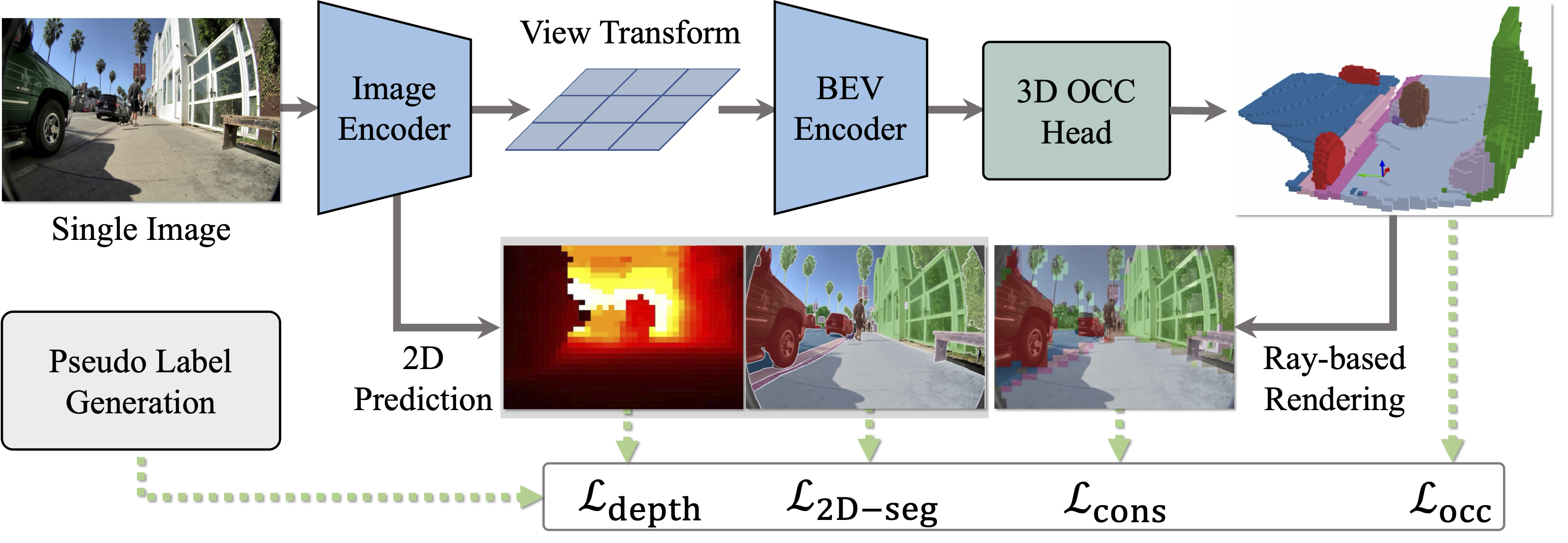
Overview of the hybrid 2D and 3D learning framework. Figure from the WalkOCC project page.
My contribution
My work focused on the 2D semantic component rather than the 3D architecture. I:
- fine-tuned SAM 3 on sidewalk-robot imagery to segment fine-grained elements including curbs, gutters, crosswalks, and driveways;
- participated in discussions of the semantic taxonomy and evaluation design;
- audited annotations and identified inconsistencies, including rider versus motorcycle segmentation and ambiguous driveway versus sidewalk boundaries; and
- supported the hybrid study’s 2D semantic component and coauthored the manuscript.
These tasks draw on my urban visual research, particularly the definition and validation of street-level categories, while extending it toward environments shared by pedestrians and autonomous machines.
Paper and project links
Ma, Y., Lin, J., Liu, L., He, H., Ricketts, L., Squicciarini, B., Liu, Y., & Zhou, B. (2026). “Monocular 3D Occupancy Perception for Robots on Sidewalks via Hybrid 2D–3D Learning.” Available as an arXiv preprint; revised manuscript in preparation.